This post contains affiliate links. Please see our disclosure policy.
This No-Knead Bread is the simplest loaf of bread you’ll ever make! It has a flexible dough rest timeline and is practically foolproof – so if you’ve never made homemade bread, you can feel confident starting here. You’ll feel like Martha when you serve this artisan bread alongside a bowl of homemade soup!

Photography for this recipe is courtesy of Creating Kaitlin. All other photography on Blue Bowl Recipes is done by myself, Stephanie Simmons, unless otherwise credited.
Why you’ll love No-Knead Bread:
- No Knead – Aside from a light 30-60 second knead to shape the dough, this is a no knead bread recipe! Read more about this in the FAQs below.
- Made by Hand – Since we’re really not kneading the dough, this bread is easily be made by hand – no stand mixer or fancy tools required.
- Flexible Timeline – The dough can rest anywhere from 8-18 hours, meaning this bread works around your schedule!

Ingredient Overview:
As always, the full recipe with measurements & directions can be found in the recipe card at the bottom of this post. Use the table of contents (back at the top, below the first image, to navigate).
- All-purpose flour – Spoon your flour into the measuring cup, then level it with a flat utensil for best results, or use a scale. Scooping the measuring cup directly into your flour will lead to too much flour, and a potentially dry bake. No need for any fancy bread flour, here!
- Salt – Salt adds flavor to everything!
- Yeast – Use rapid-rise or instant yeast, instead of active dry yeast.
- Water – Water is essential in bread recipes – it provides hydration.
- Beer – Beer gives this bread delicious flavor! A mild lager is perfect – stronger beers can make the bread bitter.
Recipe Substitutions & Variations:
- Gluten-free – I have not tested a gluten-free version of this recipe!
- Dairy-free – This recipe is naturally dairy-free!
- Beer – I haven’t tested this recipe without the beer, but I think it would work with your favorite non-alcoholic beer.
How to Make Crusty Bread (Easy from Scratch!)
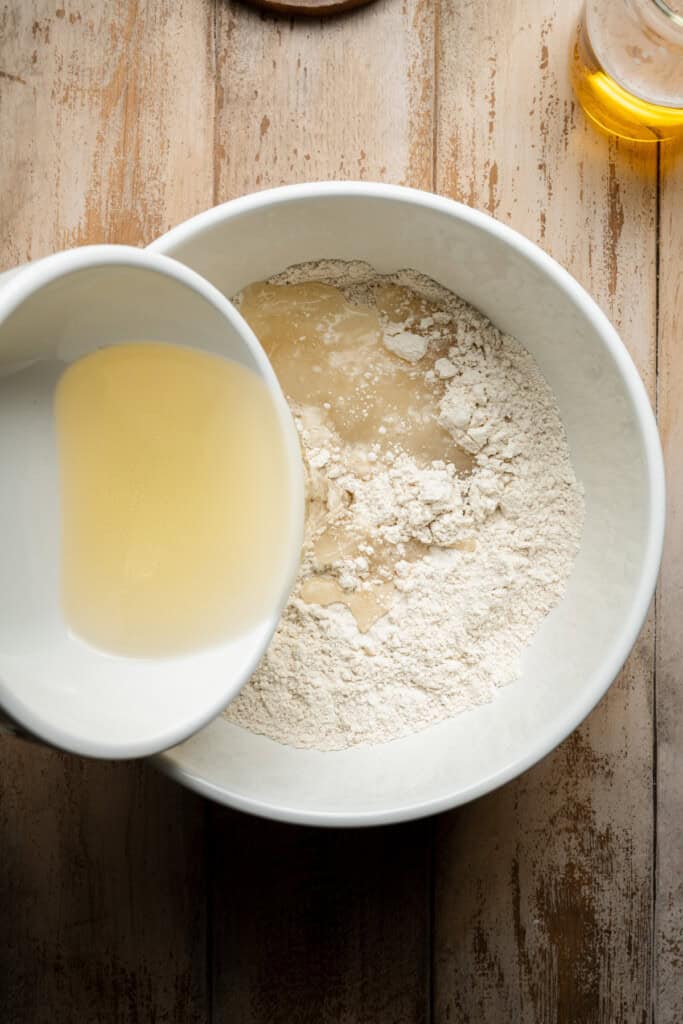
Step 1: Make the Dough & First Rise. Whisk flour, salt, and yeast together in a large bowl. Whisk water, beer and vinegar together in a separate bowl or glass measuring cup. Gently stir the wet into the dry with a wooden spoon. The dough will look scrappy and shaggy and weird.
Don’t try to shape it at all – and stop stirring once you have a scrappy dough (see photo below). Cover the bowl with plastic wrap and let sit at room temp for 8-18 hours.

Step 2: Second Rise. Transfer dough to lightly floured counter and knead for 30 seconds to 1 minute – stopping when it’s in a smooth-ish ball.
Lower the loaf into a dutch oven, using the parchment paper to lift it, letting any excess parchment hang over. Cover tightly with plastic wrap and let rise for 1.5 to 2 hours – or until loaf has doubled in size, and dough springs back minimally when poked gently.
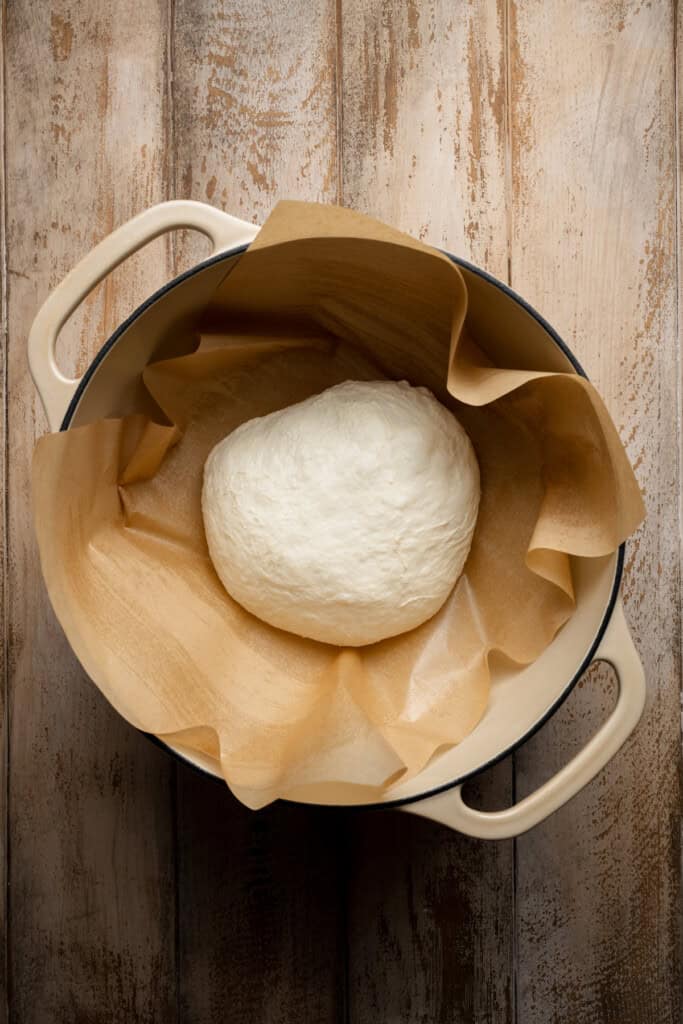

Step 3: Bake. Use a knife to score the bread. Cover the dutch oven and place in cold oven. Turn oven to 425 degrees and bake for 30 minutes. Remove lid and continue to bake until loaf is golden brown and registers 200-205 degrees F, about 23-27 minutes.

Serving + Storing:
Enjoy the bread warm from the oven, with plenty of butter or with a side of Broccoli Cheddar Soup or Chicken Wild Rice Soup.
Store the bread in an airtight container or ziploc bag at room temp for 2-3 days, or in the fridge for 4-5 days. Reheat slices in the toaster to get some of that crusty texture back!
Expert Baking Tips:
- Oven Thermometer – An oven thermometer will tell you if your oven is actually running at the temperature you set it to. Your oven may not be accurate. Accurate oven temperature is crucial for most bakes, so I leave an oven thermometer in at all times to keep an eye on my oven’s calibration.
- Kitchen Scale – A food scale is the best way to make sure your flour is at the proper weight, since amounts will vary SO widely based on how you measure it, as well as the measuring cup you use, as they are not standardized.

FAQs:
Normally, gluten develops during the kneading process (gluten development gives bread its structure – think the opposite of cake, where we mix the dry ingredients as little as possible so the cake is very tender and delicate.) An 8-18 hour rest of the dough (a process called autolyse) breaks down proteins and develops the gluten for us!

Special Tools:
- Dutch Oven – You’ll need a large, sturdy dutch oven to bake the bread in.
More Bread Recipes to Love:
- Skillet Irish Soda Bread
- One-Bowl Chocolate Chip Banana Bread
- Classic Beer Bread with Honey Butter
- Garlic Parmesan Knots
Did you make this recipe? Leave a comment & star rating!
Click the little stars in the header of the recipe card below to leave a comment & star rating, letting me know how you liked the recipe. I take all feedback seriously, & leaving a rating helps my small business immensely!

No-Knead Bread
Ingredients
- 2 cups all-purpose flour, spooned & leveled or weighed out , 270 grams
- 1 cup white whole wheat flour, spooned & leveled or weighed out , 135 grams – you can use 1 cup all-purpose flour here instead
- 1 and 1/2 tsp salt
- 1/4 tsp instant or rapid-rise yeast, Not active dry yeast
- 1/2 cup mild lager, room temperature , I use Leinenkugel's Honey Weiss
- 3/4 cup water, room temperature
- 1 tbsp white vinegar
Instructions
- Make the Dough & First Rest: Whisk flour, salt, and yeast together in a large bowl. Whisk water, beer and vinegar together in a separate bowl or glass measuring cup. Gently fold water mixture into the dry ingredients, scraping up dry flour from bottom of bowl, until dough starts to form and no dry flour remains. It will look scrappy and shaggy and weird. Don't try to shape it at all – and stop stirring once you have that scrappy bowl of dough (see photo below). Cover bowl tightly with plastic wrap and let sit at room temp for 8-18 hours.2 cups all-purpose flour, spooned & leveled or weighed out , 1 cup white whole wheat flour, spooned & leveled or weighed out , 1 and 1/2 tsp salt, 1/4 tsp instant or rapid-rise yeast, 1/2 cup mild lager, room temperature , 3/4 cup water, room temperature , 1 tbsp white vinegar
- Second Rest: Spray a large piece of parchment paper with cooking spray and set on counter. Next, transfer dough to lightly floured counter and knead for 30 seconds to 1 minute – stopping when it's smooth. Form a ball the best you can – doesn't need to be perfect! Lower the loaf into a dutch oven, using the parchment paper to lift it, letting any excess parchment hang over. Cover tightly with plastic wrap and let rise for 1.5 to 2 hours – or until loaf has doubled in size, and dough springs back minimally when poked gently.
- Bake: Next, use a knife to score the bread, making two slashes to form a cross. Cover the dutch oven and place in cold oven. Turn your oven on to 425℉ and bake for 30 minutes while the oven heats. Remove lid and continue to bake until loaf is golden brown and registers 200-205℉ in the center, about 23-27 minutes. Lift the parchment paper out of the pot to transfer bread to counter, and enjoy warm!
- Serve & Store: Enjoy immediately, while piping hot, with plenty of salted butter! Store leftovers, cooled at room temperature, in an airtight container for 2-3 days.
Notes
Nutrition
Nutrition information is automatically calculated, so should only be used as an approximation.